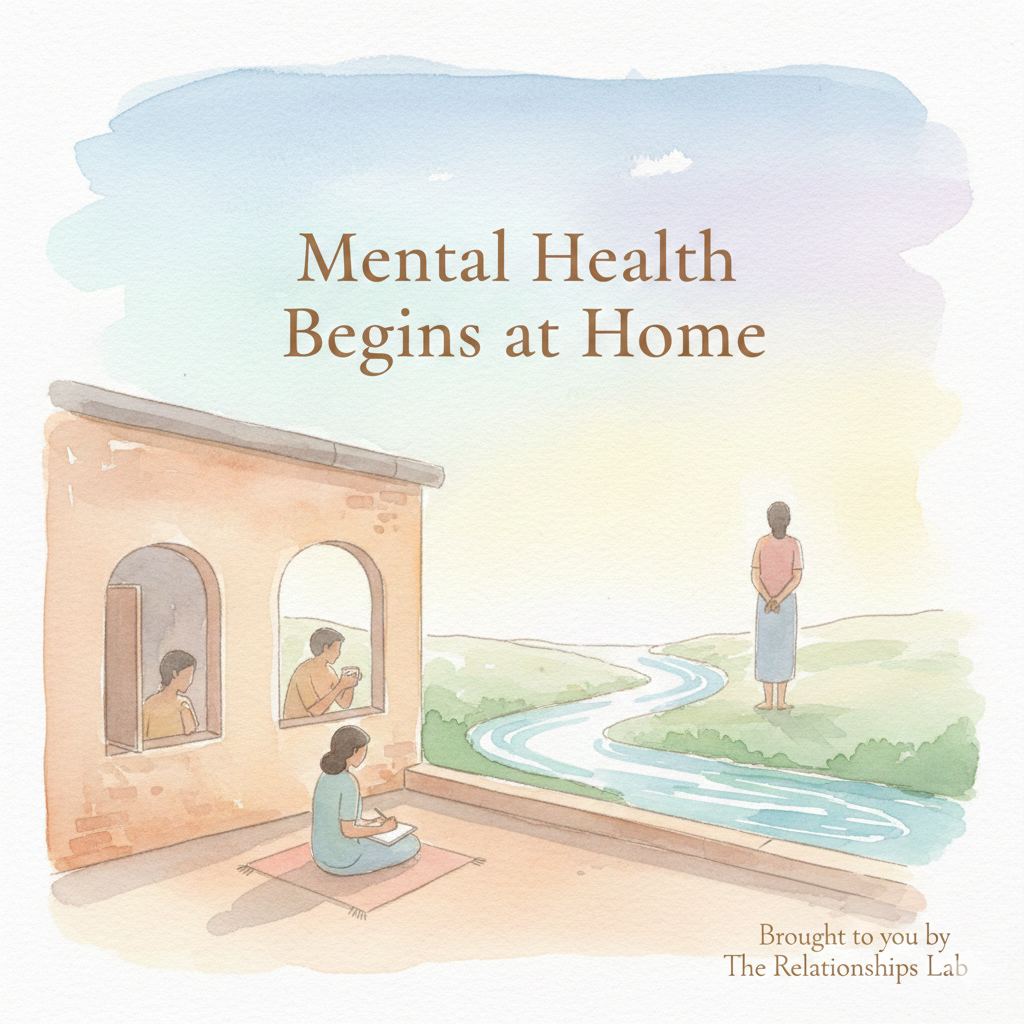
Mental Health Begins at Home: A Timely Step Towards a Healthier India
Why prevention, culture, and everyday habits matter as much as institutions
04-02-2026 • 6 min read
A Welcome and Necessary Step
The Government of India’s recent announcement to establish a National Institute for Mental Health Care in North India, modeled on the success of NIMHANS, is a move worth applauding.
At a time when emotional burnout, anxiety, relationship strain, and silent psychological distress are becoming increasingly visible across age groups, this initiative sends an important signal: mental health is no longer a peripheral concern—it is central to national wellbeing.
Institutions of national importance play a critical role:
- advancing research,
- training mental health professionals,
- shaping policy,
- and legitimizing conversations that were once whispered or ignored.
But even as we celebrate this milestone, it invites a deeper reflection.
Mental Health Does Not Begin in Hospitals
Mental health does not begin at diagnosis.
It begins much earlier—
in homes, classrooms, workplaces, relationships, and daily routines.
Long before distress becomes a clinical condition, it exists as:
- chronic irritation,
- emotional withdrawal,
- impulsive reactions,
- unspoken resentment,
- a persistent sense of “something being off.”
These are not illnesses yet.
They are signals.
A national institute can treat and study mental health—but a mentally healthy society must be cultivated daily, at the grassroots, in ways that feel familiar, acceptable, and culturally grounded.
The Case for Preventive, Doorstep Mental Health Care
India’s strength has always been its community fabric—families, elders, shared rituals, storytelling, and collective meaning-making.
Preventive mental healthcare in the Indian context must therefore:
- meet people where they are, not only where clinics are,
- speak in everyday language, not just diagnostic labels,
- respect cultural realities rather than importing one-size-fits-all models.
Simple, preventive awareness—delivered at doorsteps, schools, RWAs, offices, and digital spaces—can help people notice:
- how they react under stress,
- how often they suppress emotions,
- how quickly small habits turn into emotional patterns.
This is not therapy.
This is mental hygiene—as essential as brushing one’s teeth.
Micro-Habits, Macro Consequences
Mental health is shaped less by dramatic events and more by micro-habits:
- How do I respond when I feel misunderstood?
- Do I pause before reacting, or do I react automatically?
- How often do I feel present with loved ones—without distraction?
- Do I allow myself rest without guilt?
- How do I speak to myself when I fail?
These tiny, repeated patterns quietly sculpt our inner world.
Over time, they influence:
- emotional resilience,
- self-worth,
- decision-making,
- and most visibly—our relationships.
Many relationship conflicts are not about incompatibility.
They are about unexamined inner habits colliding with each other.
Relationships as Mental Health Mirrors
Our closest relationships are the most honest mirrors of our mental health.
They reveal:
- emotional availability or avoidance,
- trust or fear,
- patience or impulsivity,
- empathy or defensiveness.
When mental health awareness becomes part of daily life—not just crisis intervention—relationships transform from battlegrounds into spaces of growth.
A society that learns to notice itself becomes a society that heals itself.
An Invitation, Not Just an Announcement
The government’s initiative gives us infrastructure.
But culture gives it life.
Let this announcement not remain a distant policy headline, but a personal invitation:
- to reflect on our daily mental habits,
- to normalize conversations about emotional wellbeing,
- to accept that mental health is not a weakness, nor a luxury,
- but a shared responsibility.
Institutions can guide us.
Policies can support us.
But the real work happens quietly—
in how we live, relate, pause, and choose—every single day.
Strong nations are built not only by economic growth and infrastructure, but by emotionally aware, psychologically resilient human beings.
This step is promising.
May it also inspire us to look inward.